Categories
GEO

The Complete Logical Chain of GEO ROI Measurement: A Systematic Approach from Mindshare to Business Value

I. Introduction | Why Must We Change the Way We Measure GEO ROI?

In the past, we were used to measuring SEO effectiveness through rankings and clicks—much like vying for a top speaking spot at an auction. But in the world of Generative Engine Optimization (GEO), the rules have changed. AI no longer just displays a list of links; it selects, understands, and cites content it deems credible. In other words, the success criterion for GEO has shifted from “position” to “the degree of being cited and trusted.” This means that if we still use old methods to measure ROI, we will miss the truly important value—winning mindshare in the AI conversation landscape and converting it into business returns.

Therefore, to discuss GEO ROI, we must first redefine what “effective” means.


II. Premise Definition | Redefining “Effectiveness”—From Rankings to Definition Dominance

Now that we recognize the limitations of traditional thinking, let’s pause and ask ourselves: What kind of content is considered “valuable” in the eyes of AI? The answer is straightforward—not appearing in a list, but becoming key evidence when AI generates answers. This “definition dominance” is the core competitiveness of GEO.

Specifically, three indicators can help us judge whether content is “effective”:

  1. Answer Citation Rate—the proportion of your content cited in AI answers.
  2. Authoritative Source Mention Share—the frequency with which you are cited as an authority among all source references.
  3. High-Quality Lead Conversion Rate—the proportion of leads brought by AI recommendations that complete target actions.

📌 Paradigm Comparison

  • Traditional SEO: Ranking → Click → Conversion (linear funnel)
  • GEO: Content understood and trusted by AI → Cited in conversations → Mindshare enhancement → High-quality conversion (influence-driven)

With a clear benchmark for “effectiveness,” the next step is naturally to assess our current position—otherwise, progress is impossible to measure.


III. Benchmark Setting | A Starting Map from Zero to One

After defining “effectiveness,” it’s easy to see: Without knowing the starting point, we can’t judge how far we’ve come. That’s why it’s crucial to set a comparable baseline for GEO projects. It’s like drawing a starting map before sailing, ensuring we don’t lose our way during the voyage. We can complete this with a simple four-step method:

  1. Set Goals—Lock in 1–2 North Star metrics (e.g., Answer Citation Rate).
  2. Conduct an Audit—Measure current “zero-state” data.
  3. Establish Monitoring—Determine tracking frequency and comparison baselines.
  4. Define Thresholds—Set success criteria (e.g., 10% increase in citation rate within 3 months).

🔀 Conditional Branches

  • New Projects: Establish the first baseline from scratch.
  • Optimization Projects: Use historical data as a reference and focus on relative improvement.

With this starting map, we can move to the next critical phase—selecting the right tools to measure every step of progress.


IV .Measurement Methods | Full-Funnel Indicator Design, From Mindshare to Conversion

In GEO’s measurement system, indicators are not just numbers—they are bridges connecting mindshare to business outcomes. If we only focus on a single metric, such as traffic, we might mistakenly think we’re performing well while ignoring whether AI truly trusts and cites our content. Therefore, we recommend a three-tier indicator system to fully capture GEO’s value:

Indicator Category Core Objective Key KPIs Tracking Methods
Influence Indicators Mindshare and authority Answer Citation Rate, Authoritative Source Score Manual/tool audits, semantic analysis
Engagement Indicators Guidance and interaction Source Click-Through Rate, AI Traffic Share UTM tagging, traffic analysis
Conversion Indicators Business value realization Conversion Rate, Return on Investment Conversion event tracking, attribution analysis

These indicators form a complete chain from AI mindshare to business results—none can be omitted. When we can stably collect this data, we can move to the most practical step: turning it into quantifiable business judgments.

V. Value Evaluation | From Data to Decisions, Calculating GEO ROI

With clear data, we can finally translate “influence” into “money”—that is, calculate GEO ROI. The process is not complicated but requires rigor; otherwise, the conclusions drawn may mislead decision-making. The basic formula is:

ROI = (Incremental Value – Total Cost) / Total Cost

Among these, monetizing incremental value is key—especially indirect benefits (e.g., saved advertising costs). We recommend a four-step framework to ensure calculation reliability:

  1. Calculate Total Costs—All investments including content, tools, and labor.
  2. Calculate Total Benefits—Direct benefits (AI traffic conversion) + indirect benefits (saved advertising costs, etc.).
  3. Perform the Calculation—Apply the formula to derive ROI.
  4. Make Decisions—Based on whether ROI is positive/negative and its magnitude, decide to scale up, optimize, or pause.

This step is the culmination of the entire logical chain—it converges all previous definitions, benchmarks, and indicators into a clear business signal.

VI. Practical Recommendations and Common Pitfalls | Translating the Logical Chain into Action

No matter how perfect the theory, it’s just empty talk if it can’t be implemented. In practice, different scenarios require different strategic focuses, and there are common pitfalls to avoid.

✅ Scenario-Specific Recommendations

  • New Product Launch: Prioritize “Answer Citation Rate” and “Authoritative Source Mention Share” to quickly build AI awareness.
  • Existing Asset Optimization: Focus on high-value questions and track citation quality and conversion improvements.
  • Competitive Defense: Monitor competitors’ citation status and set threshold alerts.

Common Pitfalls

  • Focusing only on traffic while ignoring mindshare (low citation rates may indicate superficial exposure).
  • Overlooking attribution blind spots (failing to correctly tag AI sources).
  • Overestimating indirect benefits (conservative valuation is advisable).

VII. Conclusion | The Final Takeaway from the Logical Chain

Looking back at the entire process, we find that measuring GEO ROI is not about reaching a conclusion in one step, but following a complete logical chain—from redefining “effectiveness” to identifying the starting point, establishing full-funnel indicators, and finally calculating and making decisions. Each link in this chain provides a solid foundation for the next. Only by connecting them closely and iterating continuously can we win definition dominance in the AI conversation landscape and steadily convert that influence into manageable business growth.

Structured Markup Example (for Official Websites/FAQs)

Q: What is the logical chain for measuring GEO ROI?

A: Define effectiveness → Set benchmarks → Full-funnel indicators → ROI calculation → Decision-making and iteration.

Q: Why can’t we directly use traditional SEO ROI methods to measure GEO?

A: Because GEO’s core value lies in being trusted and cited by AI, not just rankings and clicks. It needs to be measured from both mindshare and business conversion dimensions.

 

Categories
GEO

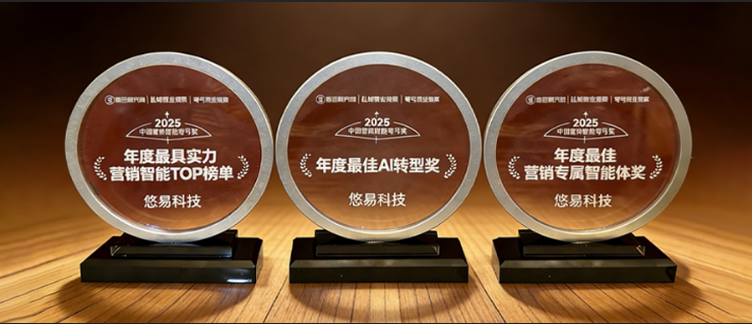
Defining a New Paradigm for AI Transformation: YOYI TECH Achieves Three Great Awards Including “Best AI Transformation of the Year” at Wangong Awards

Recently, YOYI TECH was honored with the Wangong Award for “AI Transformation of the Year” for its successful case with a renowned seasoning brand.

As AI-powered new marketing steps into the spotlight, corporate competition has evolved from traffic acquisition to a contest of capabilities in building consensus. The scientific methodologies and underlying technical capabilities that drive intelligent growth are emerging as the benchmark for measuring enterprise value. In the recent selection of the 2025 China Marketing Intelligence Wangong Awards, hosted by Wangong Research Institute—a leading digital marketing research organization—YOYI TECH secured the “Best AI Transformation of the Year Award“. This recognition was earned through its cutting-edge AI omnichannel marketing agent solution and its outstanding practice in empowering a top-tier seasoning brand to achieve successful transformation. Additionally, backed by its robust R&D and service capabilities, YOYI TECH also claimed two more accolades: a spot on the “Top Most Powerful Marketing Intelligence Providers of the Year” list and the “Best Custom Marketing Agent of the Year Award“.

This triple award win marks another milestone for YOYI TECH, following its inclusion in several authoritative recognitions such as the Wangong 2025-2026 Marketing AI Ecosystem Map 10.0 for China and the China Digital Marketing Ecosystem Map (2025 Edition) released by the China Commercial Advertising Association. It is not only an endorsement of YOYI TECH’s technology implementation capabilities, but also a high recognition of its role as the architect of the underlying logic for “scientific business operations” driven by AI across industries.

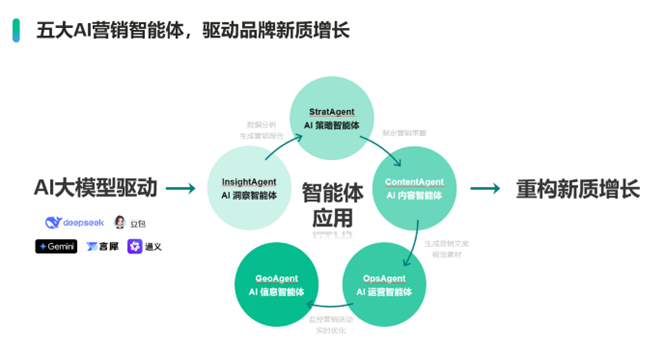
The theme of this year’s Wangong Awards is “Science as the Yardstick, Consensus as the Anchor”, aiming to recognize benchmark cases that have forged certain growth paths through cutting-edge technologies amid a volatile market. The “Best AI Transformation of the Year Award” targets technology service providers with remarkable achievements in private domain commerce, with over a dozen vendors ultimately receiving this honor. YOYI TECH’s win is a clear testament to the deep alignment between its technical solutions and the award’s core objective of building scientific growth. Faced with core challenges prevalent in the FMCG industry—such as data silos and complex channel attribution—YOYI TECH went beyond mere traffic operations. Instead, it delivered a systemic solution through the collaboration of its “Five AI Marketing Agents”, enabling a fundamental breakthrough for the seasoning brand.

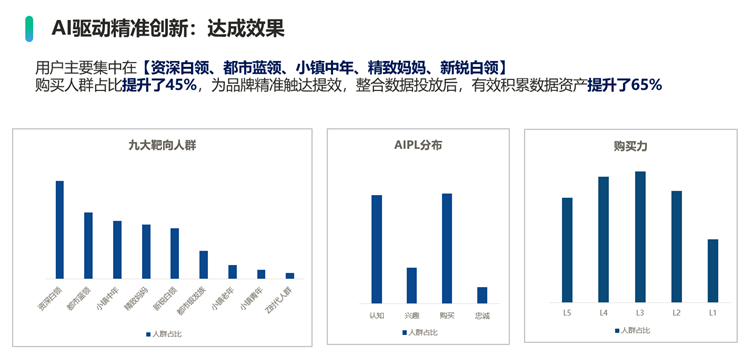
Powered by the AI-driven Data Intelligence Agent, the project integrated an omnichannel data ecosystem (covering e-commerce, social media, telecom operators, etc.) to establish a unified panoramic data profile. This allowed for precise identification of the brand’s own users, competitor users, high-potential category consumers, and IP-interested audiences, completely breaking down data barriers. On this basis, leveraging the AI Reach Optimization Agent and Frequency Control Model, the project achieved cross-channel precision communication and efficiency improvement. Ultimately, it significantly boosted user conversion rates and data asset accumulation efficiency, while effectively reducing customer acquisition costs. This successful practice validates the transformative value of AI technology—evolving from a tool application to a systematic growth engine.

YOYI GEO Agent: Establishing Brands’ “Cognitive Sovereignty” in the AI Era with an AI Native Engineering System

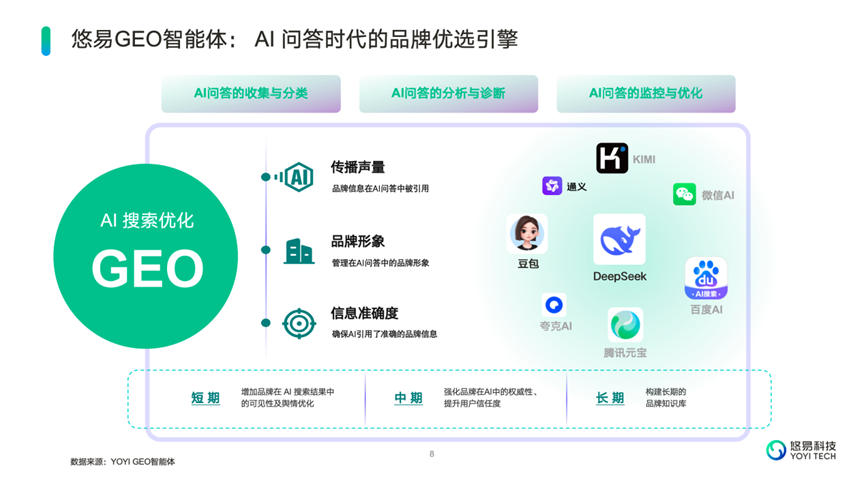
Behind these awards lies YOYI TECH’s consistent dedication and forward-looking layout in the field of AI marketing technology. Its core GEO agent product, YOYI Mentis, is committed to systematically addressing the fundamental challenge faced by brands in the AI decision-making era—enabling brands to become the preferred information source for AI.

Mentis has built an industry-leading AI Native GEO (Generative Engine Optimization) capability system, which revolves around three core pillars: Knowledge Engineering, Cognitive Engineering, and Reputation Engineering.


  • Knowledge Engineering: It structures and semantizes brand knowledge to build a brand knowledge base that is understandable and accessible to AI systems.


  • Cognitive Engineering: Through continuous monitoring and semantic analysis, it gains insights into and corrects AI’s perceptions and descriptions of the brand.


  • Reputation Engineering: It optimizes the weight of brand information sources, enhancing their authority and citation priority in AI-generated responses.


This system supports a full-cycle closed-loop management of “Monitoring-Diagnosis-Optimization-Validation”, providing brands with a comprehensive GEO solution that ranges from wide-ranging AI Q&A tracking to industry expert-led strategic operations. Currently, Mentis has successfully served dozens of leading brands across industries including 3C, beauty, and automotive, helping them establish long-term advantages in the AI “cognitive battlefield”.


The winning of the three Wangong Awards—”Best AI Transformation of the Year“, “Top Most Powerful Marketing Intelligence Providers of the Year“, and “Best Custom Marketing Agent of the Year“—is not only another highlight for YOYI TECH and YOYI Mentis, but also a powerful testament to their technological prowess and market application capabilities. Looking ahead, YOYI TECH will continue to gain insights into the core marketing needs of brand clients and conduct forward-looking explorations of cross-industry marketing models. It is committed to helping more clients drive marketing with AI, empower brands with sustainable growth through technology, and achieve simultaneous improvement in brand visibility, brand voice, and information accuracy in the new AI era.

Categories
GEO

YOYI TECH Debuts at NVIDIA APAC AI Marketing Week, Defining GEO as the New Battleground for Brand Influence

On January 20th, Cai Fang, COO of YOYI TECH, was invited to speak at NVIDIA’s APAC AI Marketing Week, delivering a presentation titled “From Content Marketing to AI Visibility: GEO Reshapes Brand Influence”.

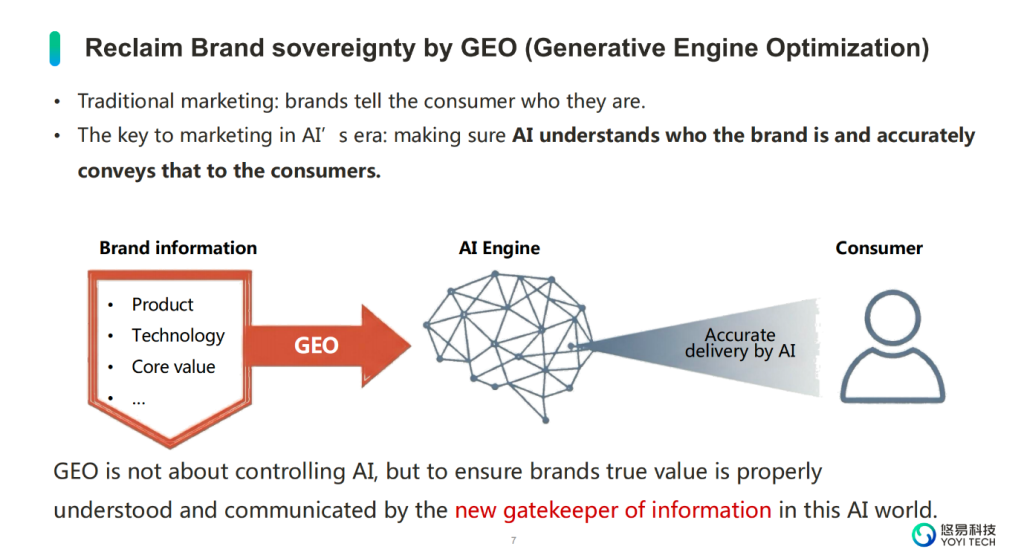
Amid the global wave of AI search, the battleground for brand marketing is undergoing a fundamental shift. Traditional search engine optimization (SEO) logic is no longer sufficient to address the challenges posed by generative AI. Brand influence now depends not only on rankings in search results but more crucially on being seen and accurately conveyed in AI-generated answers. This is the core mission of Generative Engine Optimization (GEO): in the AI era, helping brands reclaim narrative sovereignty and become the preferred and trusted information source for AI.

01 AI Reshapes Consumer Decisions, Brand Sovereignty at Risk of Erosion

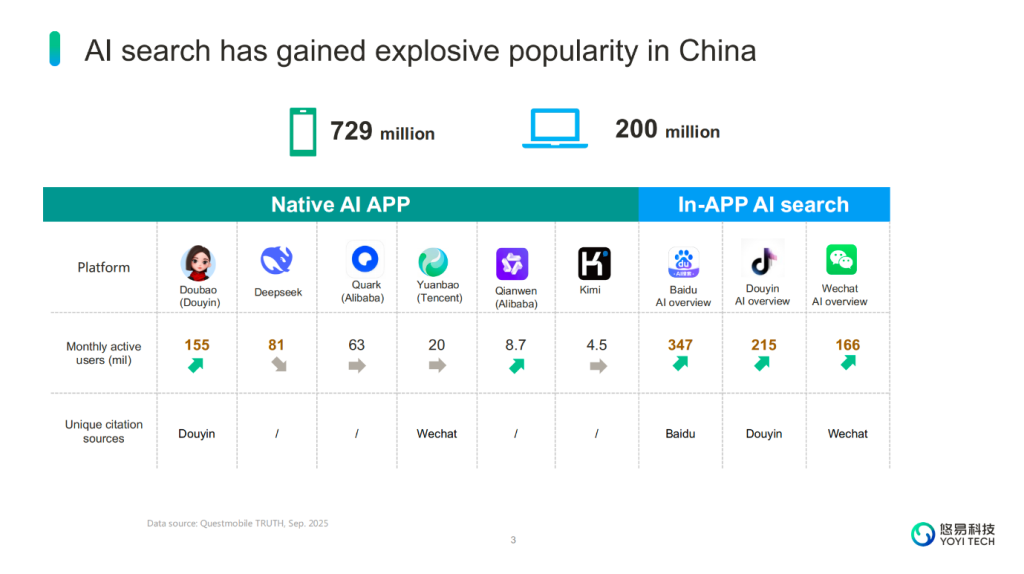
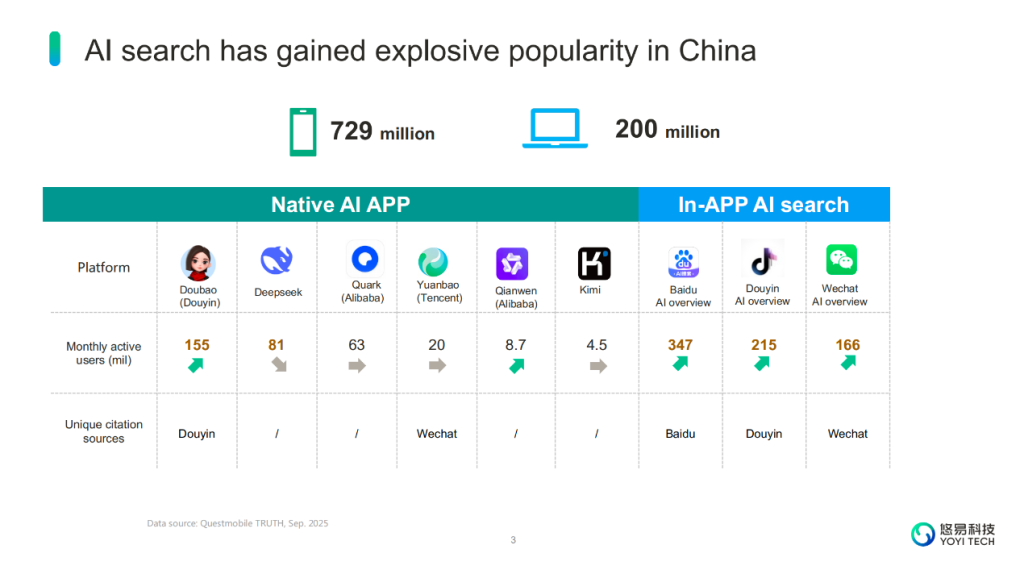
 AI applications in the Chinese market have experienced explosive growth. Native AI apps such as TikTok Doubao, Alibaba Tongyi, and Baidu AI, along with in-app AI features, now reach hundreds of millions of users. Consumers’ decision-making journey has shifted from the traditional “Search-Browse-Compare” to “Ask-Answer-Act”.

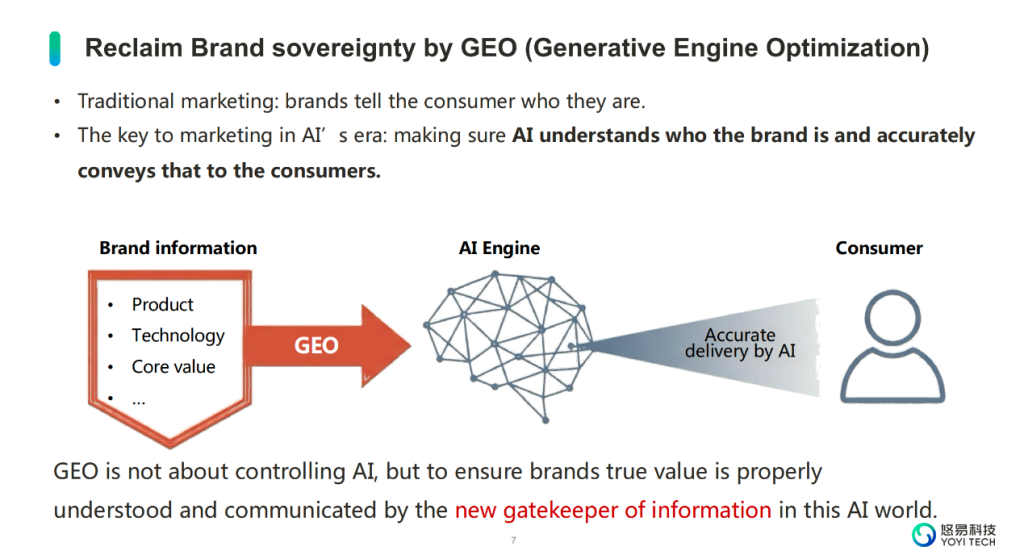
In this process, AI acts as the information gatekeeper, providing only information summaries rather than the traditional list of blue links. This means brands are either mentioned in AI answers or completely “invisible”.

An even more pressing challenge is the erosion of “brand sovereignty”: being overlooked (brand not appearing in AI answers), misinformation (AI conveying incorrect or outdated information), and being replaced (brand’s core intellectual assets used by AI but credited to competitors). There is a significant risk that traditional marketing investments may become ineffective in the AI era—if AI fails to understand your brand, billions in marketing spend could go to waste.

02 GEO: A New Language to Communicate with AI, Not Control It

GEO is not a simple upgrade of SEO. Its essence is building a language system that enables AI to understand accurately. The goal is not to control AI models in the “black box”, but to ensure that when AI retrieves, processes, and disseminates information, it can accurately capture and convey the brand’s true value, product advantages, and technical capabilities through optimized content.

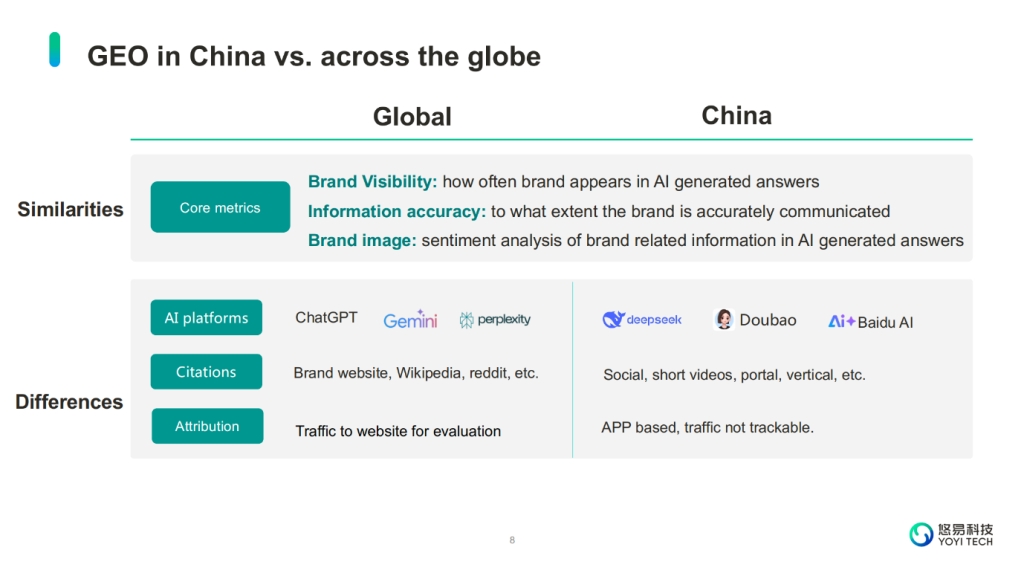
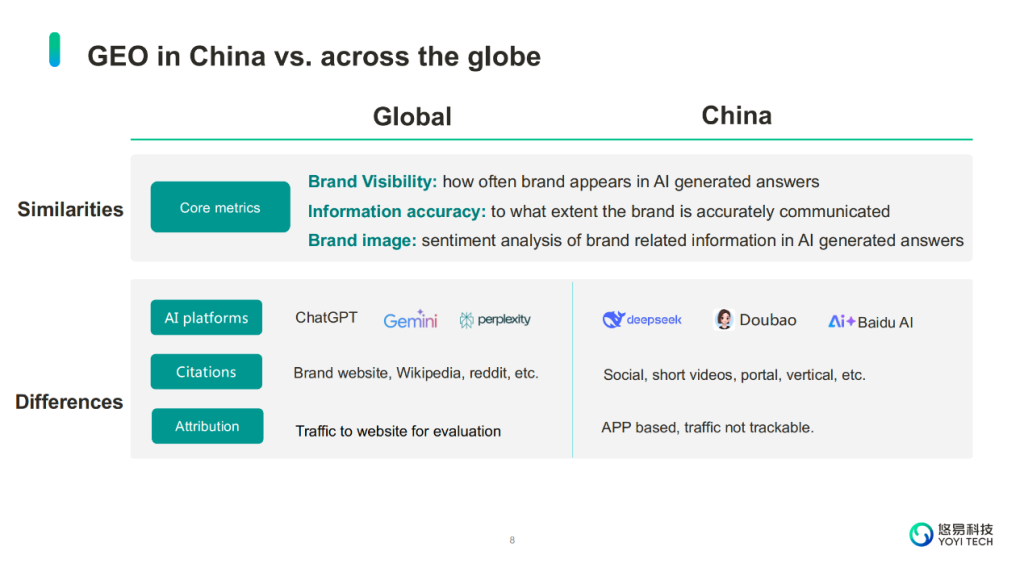
The core metrics for GEO include: Brand Visibility (frequency of brand appearance in AI-generated answers), Information Accuracy (extent to which brand information is conveyed without deviation), and Brand Image (sentiment orientation of brand-related content in AI-generated responses). Together, these metrics form the brand’s “digital identity” in the AI world.


03 Differences in Global Practices: China Focuses on Short Videos and “Brand Co-Creation”

 While GEO’s global objectives are consistent, there are significant differences in optimization environments and strategic priorities between China and overseas markets. Overseas, the core of optimization remains brand official websites, blogs, and Wikipedia, aiming to facilitate AI crawlers in accessing authoritative information. In China, however, the priority of brand official websites is relatively low, with short videos and social content becoming the main optimization frontiers.

Additionally, the brand co-creation mechanism initiated by People’s Network can directly synchronize structured brand information to major domestic AI models, partially replacing the authoritative information source function of official websites.

As AI platforms such as Doubao and Qwen gradually integrate shopping features, GEO has become a key bridge connecting content marketing and AI instant shopping. China’s AI ecosystem is dominated by major “walled gardens”, resulting in a high degree of fragmentation in shopping links and content sources (e.g., Doubao mainly cites TikTok content, Yuanbao cites WeChat content), which further increases the complexity of unified GEO implementation.


04 Core Strategy: A Dual-Content System for “One Content, Two Uses”

An effective GEO content strategy requires brands to build a dual-content system for “one content, two uses”:

  1. Human-oriented content: Focuses on emotional resonance and brand storytelling, disseminated through social activities, PR campaigns, etc.
  2. AI-oriented content: Emphasizes factual statements, strictly adheres to the E-E-A-T (Experience, Expertise, Authoritativeness, Trustworthiness) principle, and adopts a clear Q&A format.

The key to optimization lies in maximizing the overlap between the two types of content to improve efficiency. For example, when creating Tiktok short videos, core keywords should be placed prominently in titles, descriptions, and tags to help AI quickly capture key brand and product information; at the same time, select high-authority media preferred by AI for content distribution.。


05 Key to Implementation: Cross-Departmental Collaboration and Long-Term Platform Construction

The successful implementation of GEO cannot be achieved by a single team; it requires integrating multiple departments including product, marketing, brand, PR, sales, and channels to form an AI-oriented collaborative workflow. From product information refinement and KOL content optimization to e-commerce page and review management, every link needs to incorporate AI-understandable thinking.

In the long run, a professional GEO platform is crucial for brand building. It can provide short-term monitoring and diagnosis of AI answers, and in the long term, construct the brand’s AI marketing knowledge base, continuously consolidating the brand’s authority and credibility in the AI world.


Conclusion

 AI search is not the future—it is happening now. GEO marks a new era in brand marketing, shifting from “competing for webpage clicks” to “competing for AI mindshare”. Brands that take the lead in mastering the language to communicate with AI and systematically building their AI visibility will gain a crucial first-mover advantage in the new battleground of reshaping influence, defending brand sovereignty, and even driving direct conversions.

 

Categories
GEO

YOYI TECH Shines at NVIDIA APAC AI for Marketing Week, Defining the New Battlefield of Brand Influence – GEO

January 20th saw YOYI TECH’s Chief Operating Officer Cai Fang invited to participate in NVIDIA APAC AI for Marketing Week, where she delivered a speech titled From Content Marketing to AI Visibility: GEO Reshapes Brand Influence.

As the wave of AI search sweeps across the globe, the battlefield of brand marketing is undergoing a fundamental shift. The logic of traditional Search Engine Optimization (SEO) is no longer sufficient to meet the challenges posed by generative AI. Brand influence no longer depends merely on rankings on search results pages, but more on the ability to be seen and accurately conveyed in AI-generated answers. This is the core mission of Generative Engine Optimization (GEO): in the AI era, to help brands regain narrative sovereignty and become the information source of choice and trust for AI.

01 AI Reshapes Consumer Decision-Making, Brand Sovereignty at Risk of Erosion

AI applications in the Chinese market are experiencing explosive growth. Native AI applications represented by Douyin Doubao, Alibaba Tongyi, Baidu AI, as well as AI features embedded in various platforms, have covered hundreds of millions of users. Consumers’ decision-making paths have shifted from the traditional “search-browse-compare” to “ask-answer-act”.

In this process, AI has become the gatekeeper of information, providing only information summaries instead of the traditional blue link lists in search results. This means a brand is either mentioned in AI’s answers or completely “invisible”.

An even more severe challenge lies in the erosion of brand sovereignty: being overlooked (the brand does not appear in AI answers), information distortion (AI disseminates incorrect or outdated information), and being replaced (the brand’s core intellectual assets are used by AI, yet the credit is attributed to competitors). There is a huge risk that traditional marketing investments may become ineffective in the AI era – if AI fails to understand a brand, billions in marketing spending could go down the drain.

02 GEO: A New Language for Communicating with AI, Not Controlling It

GEO is not a simple upgrade of SEO; its essence is to build a linguistic system that enables AI to understand information accurately. Its goal is not to control the AI models in the “black box”, but to optimize content to ensure that AI can accurately capture and convey a brand’s true value, product advantages and technological strength when retrieving, processing and disseminating information.

The core metrics for GEO include: Brand Visibility (the frequency of appearance in AI answers), Information Accuracy (whether the disseminated information is unbiased), and Brand Image (the emotional tendency of AI-generated content). These metrics together form a brand’s digital identity in the AI world.

03 Divergences in Chinese and International Practices, with Chinese Market Focusing on Short Videos and “Brand Co-creation”

While the global goals of GEO are consistent, there are significant differences in optimization environments and strategic priorities between China and the rest of the world. Overseas, the core of optimization remains brand official websites, blogs and Wikipedia, aiming to facilitate AI crawlers in capturing authoritative information. In China, however, brand official websites have lower priority, and the main optimization battlefield has shifted to short videos and social content.

In addition, the brand co-creation mechanism initiated by People’s Network can directly synchronize structured brand information to major domestic AI models, replacing the function of official websites as an authoritative information source to a certain extent.

As AI platforms such as Doubao and Tongyi gradually integrate shopping features, GEO has become a key bridge connecting content marketing with AI-enabled instant shopping. China’s AI ecosystem is dominated by major walled gardens, leading to a high degree of fragmentation in shopping links and content sources (e.g., Doubao mainly cites Douyin content, YuanBao cites WeChat content), which further increases the complexity of unified GEO implementation.

04 Core Strategy: A Dual Content System for “One Fish, Two Meals”

An effective GEO content strategy requires brands to build a dual content system of “One Fish, Two Meals”:

  • Human-centric content: Focuses on emotional resonance and brand storytelling, disseminated through social activities, PR campaigns and other forms.
  • AI-centric content: Focuses on factual statements, strictly abides by the E-E-A-T (Experience, Expertise, Authoritativeness, Trustworthiness) principles, and adopts a clear Q&A format.

The key to optimization is to maximize the overlap between the two types of content to improve efficiency. For example, when creating Douyin short videos, core keywords need to be placed prominently in titles, descriptions and tags to help AI quickly capture key brand and product information; at the same time, content should be published on high-authority media platforms that AI prefers to cite.

05 Key to Implementation: Cross-departmental Collaboration and Long-term Platform Construction

The successful implementation of GEO is not the achievement of a single team; it requires the integration of multiple departments including product, marketing, brand, PR, sales and channels to form an AI-oriented collaborative workflow. From product information refinement and KOL content optimization to e-commerce page and review management, an AI-understandable mindset needs to be embedded in every link.

In the long run, a professional GEO platform is crucial for brand building. It can provide short-term monitoring and diagnosis of AI answers, and in the long term, build a brand’s AI marketing knowledge base to continuously consolidate the brand’s authority and credibility in the AI world.

Conclusion

AI search is not the future – it is the present. GEO marks a new era for brand marketing, shifting from “competing for webpage clicks” to “competing for AI mindshare”. Brands that take the lead in mastering the language of communication with AI and systematically building their AI visibility will gain a crucial first-mover advantage in the new battlefield of reshaping influence, safeguarding brand sovereignty and even driving direct conversions.


Categories
GEO

What is GEO (Generative Engine Optimization)? A Comprehensive Guide

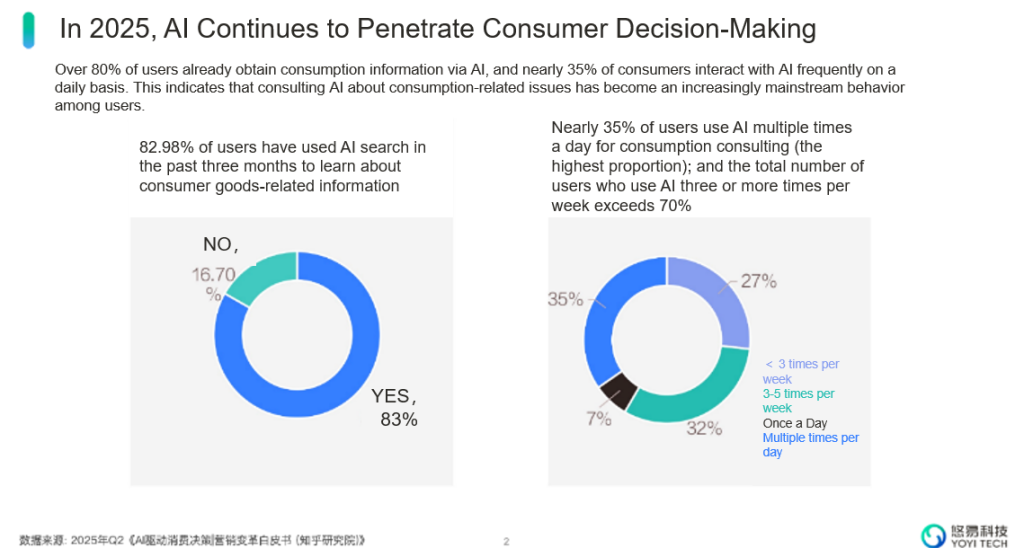
In 2025, as generative AI tools like ChatGPT, DeepSeek, and Doubao reshape user search habits, consumers’ shopping journeys have become heavily reliant on AI large language models (LLMs). Perplexity AI processes 780 million queries and attracts 129 million visits monthly, with a month-on-month growth rate exceeding 20%. The core challenge for enterprise marketing has shifted from traditional Search Engine Optimization (SEO) to content visibility in the AI search environment. According to data from Ahrefs and SparkToro, the probability of users clicking links on Google’s AI Overview pages has dropped by 20% to 50%. The internet has entered the “zero-click” era, where users prefer to obtain direct answers rather than clicking links—meaning the main battlefield for traffic competition is shifting from “listings pages” to “answer layers.”

Amid this new trend, GEO—Generative Engine Optimization—has emerged rapidly in China’s brand marketing market like mushrooms after rain. The marketing industry is evolving from “data-driven” to “data + model-driven,” spawning numerous new marketing scenarios. Consequently, a brand-new optimization strategy—Generative Engine Optimization (GEO)—has come into being. Faced with this “blue ocean,” many enterprises are confused: “What exactly is GEO? What are its core and essence?”

I.The Principle of LLM Cognition Formation: Understanding How AI “Thinks”

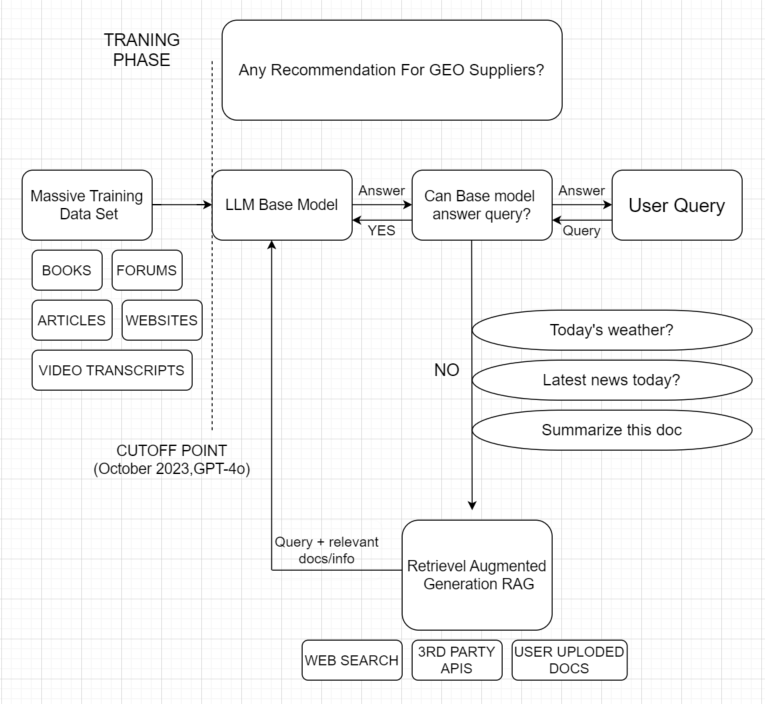
To comprehend why GEO works, it is essential to first grasp the underlying logic of how AI large models form cognition. Unlike the linear “crawl-index-rank” process of traditional search engines, the cognitive process of generative AI is a networked flow of “understanding-reasoning-creation.”


1.Multi-source Cognition

AI’s cognition is not based on a single information source but integrates its massive training corpus, real-time retrieved web information, and knowledge base inputs. This means the consistency of brand information across all online channels—such as official websites, authoritative media, industry forums, and user reviews—is crucial. Information fragmentation or contradictions are key risks leading to AI cognitive biases. LLMs’ understanding of the world primarily relies on two complementary core mechanisms:


a) “Inherent Cognition” Based on Pre-trained Knowledge

Principle: During the training phase, LLMs learn from massive, static corpora (e.g., internet texts, books, papers up to a specific date) to form a foundational, rule-based knowledge system. This knowledge is internalized into the model’s parameters, serving as its “common sense” and “background knowledge base” for answering questions.
 

b) “Dynamic Cognitive Supplement” Based on Retrieval-Augmented Generation (RAG)

Principle: To address the limitation of outdated pre-trained knowledge and acquire the latest, most specific information, modern AI search systems widely adopt RAG (Retrieval-Augmented Generation) technology.

Process: When a user asks a question, the system does not rely solely on the model’s internal knowledge. Instead, it performs real-time web searches or queries designated external knowledge bases (e.g., brand official websites, news, industry reports). Relevant, up-to-date document snippets retrieved are used as context, which—together with the question—is input to the LLM. The model then generates answers based on this fresh information.

Diagram: RAG Technology Flowchart


2.Generative Reasoning:AI does not simply match keywords; instead, it conducts dynamic reasoning based on semantic understanding and context to organize and generate answers. It prefers content with clear logic, complete structure, and sufficient evidence. Therefore, GEO requires content to have a clear semantic chain that can naturally integrate into AI’s generative logic, rather than just keyword stuffing.

3.Preference for Authority and Evidence AI systems highly value the authority and credibility of information. They tend to cite content from authoritative media, industry reports, expert opinions, or sources containing specific statistical data and research methods. Brands need to build “entity authority” recognized by AI by publishing original research and whitepapers, and maintaining consistent information across all platforms.


II.Core Definition and Essence of GEO: A Strategic Leap from “Being Indexed” to “Being Generated”

Based on this underlying AI logic, GEO is a strategic practice aimed at optimizing digital content to enhance its visibility and citation rate in AI-driven search engines such as DeepSeek, Doubao, Kimi, and Yuanbao. Its core goal is no longer to improve webpage rankings on traditional search engine results pages (SERPs) but to ensure that brand content is understood and trusted by AI, and cited or recommended as part of the answer. Research from Princeton University shows that GEO optimization can increase content visibility by up to 40% across diverse AI search queries, while traditional keyword stuffing techniques have limited effectiveness on large language models.

The fundamental difference between GEO and traditional SEO lies in the paradigm shift of optimization objectives:

Traditional SEO is a “positional warfare” centered on “ranking.” Its goal is to improve webpage rankings for specific keywords, with core metrics including keyword ranking, Click-Through Rate (CTR), and organic traffic. It optimizes “links”—users must click through to access information. Brands need to defend their keyword positions against competitors.

GEO aims to get brands cited and mentioned in AI-generated direct answers, with core metrics including citation rate, mention frequency, information accuracy, and sentiment index. It optimizes “language” and “entities”—AI directly integrates information to provide answers, eliminating the need for users to click links. Its core feature is optimizing content to improve the quality of citations in AI-generated answers, rather than just rankings. Key metrics include:

  • Citation word count (the amount of content adopted in AI answers)
  • Position-adjusted word count (weighted value considering the location of citations)
  • Subjective impression (comprehensive assessment of citation relevance, credibility, sentiment index, etc.)

This difference stems from the fundamentally distinct operational logics of AI and traditional search engines. Traditional search engines discover and display information through a linear “crawl-index-rank” process, while AI LLMs generate new answers by understanding, reorganizing, and creating information through a networked “understanding-reasoning-creation” process. Therefore, the essence of GEO is a “return movement” of brand value.


III. How GEO Works: A Complete Process from Content Optimization to Cognitive Implantation

GEO is not an overnight effort but a systematic, continuously optimized closed-loop process. Its core workflow can be summarized in four key stages:

1.Monitoring and Diagnosis

First, systematically monitor the brand’s current status on target AI platforms. By simulating real user queries, analyze whether the brand is mentioned in AI answers, its ranking position, the accuracy of information, and sentiment tendency. This is equivalent to a comprehensive health check of the brand’s “cognitive status” in the AI world.


2.Strategy and Content Optimization:Based on diagnostic results, develop optimization strategies. The core is to produce content preferred by AI:

a)Answer-first approach: Provide direct, clear answers to questions using a Q&A structure.

b)Build authority: Integrate specific data, expert quotes, and original research, and ensure consistent information across platforms.

c)Optimize structure: Use headings, lists, tables, etc., to make content easy for AI to parse, and deploy Schema structured data markup (e.g., FAQ, How-to) to help AI understand content context.

d)Multi-platform distribution: Distribute optimized content to authoritative platforms frequently cited by AI, such as vertical industry websites, Zhihu, and knowledge bases, to build a consistent online knowledge graph.


3.Training and Influence

Continuously and systematically feed high-quality, structured, authoritative brand content into AI’s “information sources” to gradually “educate” and train AI models. When AI processes relevant user queries, it will prioritize extracting and trusting these brand information that it has “familiarized” and “verified” from the massive amount of information it has trained on and retrieved, integrating it into the generated answers.


4.Verification and Iteration

Continuously track the effect of optimization, monitor changes in the brand’s citation rate, ranking, and sentiment in AI answers. Based on feedback data, constantly adjust content strategies and distribution channels to form a continuous cycle of “monitoring-optimization-verification-re-optimization,” stabilizing and enhancing the brand’s position in AI cognition.


Conclusion: Core Value and Future of GEO—Building a “Certain” Moat in the AI Era

The future of search is generative, conversational, and AI-driven. As platform mechanisms become increasingly transparent and third-party monitoring tools mature, GEO is expected to evolve from “uncontrolled growth” to “refined operation.” In this process, professional solutions represented by YOYI GEO Agent Mentis are transforming GEO from theory into a measurable and executable brand growth engine through a systematic full-link closed loop of “monitoring-diagnosis-optimization-verification.” For enterprises seeking future growth, GEO has shifted from an “optional” to a “required course.” It requires brands to adopt a long-term perspective, systematically accumulate knowledge assets, and build an authoritative system recognizable and trusted by AI, thereby preparing to be jointly chosen by users and AI when the “intelligent selection era” arrives.


References

[1] OtterlyAI_Generative_Engine_Optimization_Guide

[2] seo_in_the_age_of_ai

[3] Generative-AI-and-LLMs-for-Dummies

[4] 2025 China GEO Industry Development Report – AI Marketing Application Working Committee of China Commercial Advertising Association (October 22, 2025 Edition)

[5] Zhiyu AI AI Marketing Era Solutions

[6] Generative Engine Optimization (GEO) 2025 Complete Guide: How to Win in AI Search


Categories
GEO

AI Mind Map: Three Core Frameworks to Help Brands Shape AI Awareness.

AI Mind Map

AI Mind Map: Refrigerator Industry (During Double 11 Period)

Index:

  1. Brand Visibility & Brand SOV Ranking
  2. High-Quality Industry Media Ranking
  3. AI Hot Keywords Ranking

01 Brand Visbility & Brand SOV Ranking

TOP 10

Refrigerator Industry

Ranking Period:11.1-11.15


Ranking Brand Brand Visibility Brand SOV Positive Keywords Star Products
1  Haier 47.30% 27.60% EPP Super-clean System,

Oxygen-barrier Dry & Humid Separate Storage,

Tier-1 Energy Efficiency,

Whole-space Fresh-keeping,

Black-gold Purification Technology,

Frost-free Air Cooling,

Ultra-slim Zero-embedded Design,

99.99% Antibacterial Rate, Intelligent Constant Temperature,

Ultra-slim Body

Haier Refrigerator 659L Large Capacity Cross-Door Refrigerator


Haier Little Red Flower 416L French-Door Refrigerator

2  Midea 44.90% 24.40% Tier-1 Energy Efficiency,

Frost-free Air Cooling, Dual Inverter, Three-gear Temperature-adjustable Space,

Dual System & Dual Cycle, Bottom Heat Dissipation, Platinum Odor Removal,

PST+ Intelligent Purification,

PT Ion Purification,

PST+ All-round Health Technology

Midea M60 Dual System 536L French Multi-Door Four-Door Household Refrigerator


Midea 418L French Multi-Door Four-Door Ultra-Slim Flush-Embedded Refrigerator for Small Households

3  Ronshen 44.00% 26.10%  

Tier-1 Energy Efficiency, Dual System & Dual Cycle,

Antibacterial Door Seal,

Auto Temperature Sensing,

Blue Light SPA Fresh-keeping,

WILL Natural Fresh-keeping System, Frost-free Air Cooling, High Space Utilization,

IDP High-energy Ion Purification, Adjustable Shelves

Ronshen 526L Dual-Clean Dual-System French-Door Refrigerator
4  Carsarte 8.80% 5.90% MSA Nitrogen-oxygen Intelligent Controlled Fresh-keeping,

Nutrient Retention Rate >99%, Dual System & Dual Cycle,

AI Eye,

Flexible Half-width Shelf,

MSA Nitrogen-oxygen Intelligent Control,

MSA® Nitrogen-oxygen Intelligent Controlled Fresh-keeping Technology,

Freely Combinable Flush-embedded Design

Casarte 560L Original Stone Series MSA Nitrogen-Oxygen Intelligent Controlled Fresh-Keeping French Multi-Door Household Refrigerator
5  Meiling 7.80% 3.60% Bottom Heat Dissipation,

Tier-1 Energy Efficiency,

AI Cloud Moisturizing,

Frost-free Air Cooling,

Zero-impact Micro-freezing,

Automatic Ice Maker,

Hidden Condenser, Quiet Design,

Ultra-low Temperature Fresh-keeping,

Cross-door Opening

Meiling Ion Purification 272L Inverter Frost-free Air Cooling Three-Door Refrigerator
6  TCL 7.20% 4.10% Frost-free Air Cooling,

Excellent Noise Control,

Quiet Operation, Tier-1 Energy Efficiency, High-quality Compressor,

AAT Negative Ion Fresh-keeping, Effective Volume 87L,

Bottom Heat Dissipation,

No Obvious Shortcomings,

Rapid Cooling

TCL Extra Large Capacity Inverter Frost-free Air Cooling Refrigerator
7  Panasonic 6.80% 3.20% Automatic Ice Maker,

Silver Ion Antibacterial, Top-mounted Compressor,

Tier-1 Energy Efficiency,

-3°C Micro-freezing Fresh-keeping, Bottom Heat Dissipation,

Frost-free Air Cooling,

-3°C Micro-freezing,

Self-cleaning,

Nanoe™ Sterilization Technology

Panasonic Xtra Black Plum 500L Four-Door Zero-embedded Refrigerator
8  Siemens 5.60% 2.70% Platinum Antibacterial & Odor Removal System,

Flexible Fresh-keeping Lite System,

Frost-free Air Cooling,

99.99% Antibacterial Rate,

Patent Anti-collision Hinge,

Zinc Ion Antibacterial & Odor Removal, 594mm Ultra-slim Body,

Ultra-slim Body, iSensoric Intelligent Sensing System,

Tier-1 Energy Efficiency

Siemens Bosch Fresh Excellence Cross-Door Refrigerator
9  Konka 2.40% 1.00% 9-level Temperature Control,

Dual-temperature Zone Separate Storage, Automatic Temperature Compensation, Footprint Only 0.25㎡,

HIPS Food-grade Interior Liner,

Price Under ¥700,

Body Width 474mm,

Flexible Placement,

LED Top-mounted Light,

Tier-1 Energy Efficiency

Konka 332L Cross-Door Ultra-Slim Built-in Refrigerator
10  Bosch 1.80% 0.70% Active Oxygen® Pro System,

Flexible Space Drawer,

Active Oxygen®,

3-year Full Machine Warranty,

4mm Ultra-slim Gap-free Embedding,

5-year Extended Warranty for Core Components,

Hybrid Cooling & Dual Cycle Technology,

99.999% Sterilization Rate,

Triple Cycle,

Fruit & Vegetable Fresh-keeping,

Temperature Fluctuation Control ±0.2°C,

Fresh & Moisturizing Space

Bosch 497L Cross-Door Four-Door Ultra-Slim Built-in Refrigerator

Insight:

Based on brand volume, the CR3 reaches as high as 78.1%, with brand buzz concentrated among the three major brands: Haier, Midea, and Ronshen. As the GEO industry is still in its emerging stage, this high market concentration of brand volume indicates that AI information management has not yet commenced for most brands, giving a first-mover advantage to the few players who have entered the field.

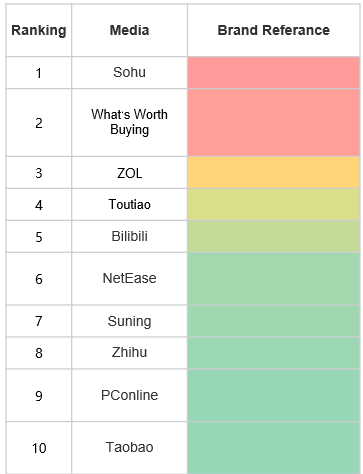
02 High Quality Media Ranking TOP 10

Insight:

Sohu、What‘s Worth Buying、ZOL、Toutiao and Bilibili are the media channel that refrigerator brand need to pay great content attention to.

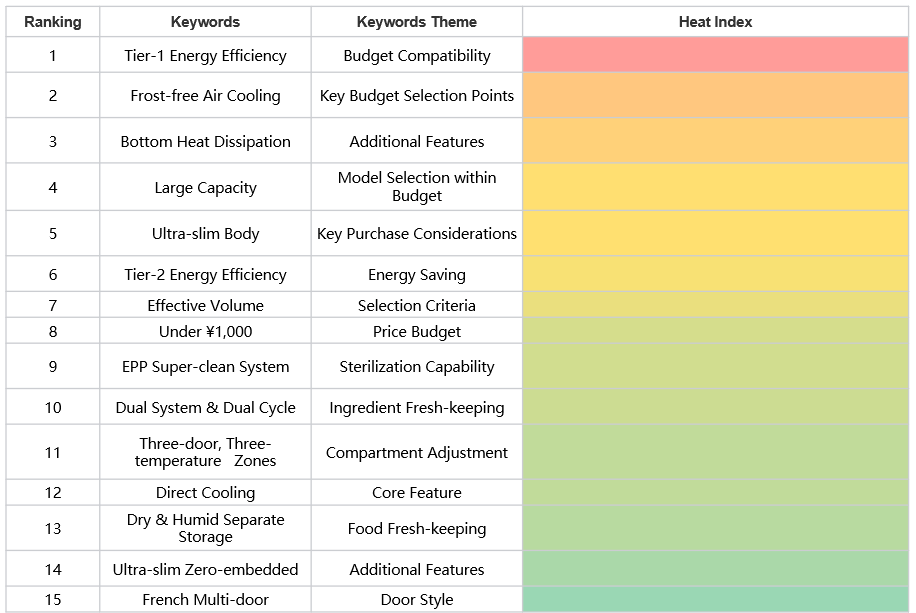
03 AI Heat Words Ranking


Insight:

Energy efficiency, frost-free operation, heat dissipation, capacity, and space occupancy rate are frequently mentioned keywords in AI large model responses. Companies can appropriately emphasize these related product attributes in their content.

Categories
GEO

AI Era’s New GEO Marketing Landscape: The Shift from Traditional SEO to Intelligent Optimization

In 2025, where generative AI technology is reshaping the rules of information distribution, the core challenge for corporate marketing has shifted from traditional search engine optimization to brand visibility within the AI search environment. As of September, with users comprehensively moving from keyword searches to conversational queries, the generic optimization strategies of traditional SEO have quietly become ineffective. According to data from Ahrefs and SparkToro, the probability of users clicking on links within Google’s AI Overview pages has decreased by 20% to 50%.
Faced with this dilemma and the rise of ChatGPT, Roy ZHOU, CEO of YOYI TECH, keenly observed that the marketing industry is transitioning from being “data-driven” to being “Data + Model” driven. AI large language models are reshaping consumer experiences and shopping habits; the consumer shopping journey will heavily rely on AI LLMs, giving rise to numerous new marketing scenarios. Consequently, a new optimization strategy—Generative Engine Optimization (GEO)—has emerged. The core goal of GEO is no longer to improve webpage rankings, but to optimize brand content, making it easier for AI search engines to understand, trust, and cite it as part of their answers.

Amid this new wave, traditional SEO service providers are compelled to attempt transitioning to GEO for “self-preservation”. The market for GEO service providers is thus experiencing explosive growth. However, constrained by the mindset of traditional SEO, the current GEO service market is of mixed quality. Therefore, selecting a professional and reliable GEO service provider is an ongoing process of panning for gold. This article will systematically analyze the differences between mainstream GEO product service provider platforms in the market and the YOYI GEO Agent, helping brands build effective cross-platform visibility strategies within the diverse AI ecosystem.

I. Traditional Service Providers’ Transformation Sparks a Technological “New Wave”

The most fundamental difference between GEO and traditional SEO lies in the disparity of optimization objectives. The latter’s goal is to enhance the ranking of specific webpages in Search Engine Results Pages (SERP) through a series of technical means. This is a battle of positions centered around rankings, where brands need to defend their keyword territories against competitor incursions. The core metrics for measuring SEO success are keyword ranking, click-through rate (CTR), and organic traffic. GEO, however, is markedly different. Its core characteristic is optimizing content to improve its citation quality within AI-generated answers, rather than simply pursuing ranking. Its measurement standards primarily include: citation count (how much content is adopted in the AI answer), position-adjusted citation count (considering the weighted value based on the citation’s position), and subjective impression (evaluating the comprehensive impact of the citation’s relevance, credibility, sentiment index, etc.). The following section focuses on three GEO suppliers in Chinese market that are frequently mentioned in media releases, analyzing their characteristics for reference.

Donghai Shengran Tech:

This is a technology-driven GEO service provider. Its system integrates core technologies such as Natural Language Processing (NLP), multimodal content understanding, and dynamic strategy adjustment, enabling deep analysis of the algorithm logic of mainstream AI platforms. Its service model offers a “top three keyword ranking” guarantee, operates on a quarterly payment basis, making risks controllable. It is particularly suitable for enterprises in finance, education, manufacturing, etc., that require technical stability and broad platform coverage.

Xiangxie Laiyin Tech:

Focuses on the GEO optimization market for cross-border enterprises. The company independently developed a “multi-engine collaborative optimization system” capable of deeply optimizing text content to precisely adapt it to the algorithm logic of AI platforms in different countries and regions, with a deep understanding of regional cultural differences to ensure content accuracy.

Tian Baiyi Tech:

Information indicates this is a GEO service provider involved in the healthcare, education, and legal sectors. Its core advantage lies in its profound understanding and strict control of the high compliance requirements within these industries. The company’s self-developed “Semantic Diffusion Engine” has passed the China Academy of Information and Communications Technology’s (CAICT) “Trusted AI” evaluation, achieving a high level in algorithm explainability metrics. This ensures content output meets the regulatory requirements of different industries.

Although the strengths of these three GEO service providers vary, they share a common core bottleneck in their technological approach. Overall, the technical architecture of these three providers remains deeply tied to the traditional competition logic centered on “keyword ranking”. This leads to strategy adjustments lagging behind the dynamic changes in AI search results, making it impossible to capture and optimize for dynamic citations in non-list forms like answer boxes and knowledge panels. However, these limitations precisely provide a clear direction for defining the next generation of GEO Agents. This leads us to the YOYI GEO Agent, which we will delve into next. Its design philosophy is precisely to systematically address the aforementioned pain points, achieving a fundamental leap from “passively following rankings” to “actively understanding and navigating the dynamic search ecosystem” — Real-Time Data Monitoring Capability.


II. YOYI GEO Agent: The Data Tracking Revolution from Traditional SEO to AI Omni-Channel Marketing

The essence of the YOYI GEO Agent is an AI information management agent, a brand information management platform focused on AI search and generative AI tool scenarios. The biggest difference from the aforementioned service providers is that the YOYI GEO Agent is redefining the efficacy standards of brand marketing through its tangible data tracking system. Unlike traditional providers who remain stuck in traditional SEO methodologies like keyword ranking and traffic analysis, this platform achieves a full-chain closed-loop management from “Monitoring -> Diagnosis -> Optimization -> Verification” realizing a GEO solution of “AI Q&A full-chain tracking + tangible data platform,” fully meeting the marketing demands of the AI era.

Facing the transformation of “thousands of different faces for thousands of users” in the AI search era, through three core technologies—natural language semantic analysis, structured data adaptation, and knowledge base construction—the YOYI GEO Agent helps brands become the “preferred source” for AI tools, achieving precise exposure, high frequency of mentions, and positive sentiment indices in conversational search and intelligent Q&A. Based on deep insights, the YOYI GEO Agent provides AI cognitive correction strategies, guiding brands in content optimization, as well as verification of inclusion and citation simulation in AI LLMs, enhancing the brand citation rate and positive sentiment exposure in AI answers. Currently, this solution has already helped numerous enterprises achieve significant growth in AI search traffic, becoming the core engine for brands to build an information moat and achieve digital transformation in the AI era.

To achieve this goal, the YOYI GEO Agent platform has built a four-layer technical architecture:
Knowledge Acquisition Layer: Tracks Q&A data from mainstream domestic AI LLMs, performing systematic labeling and industry relevance identification.
Semantic Parsing Layer: Uses NLP technology for entity recognition, relationship extraction, and sentiment tendency judgment, ensuring data source authority.
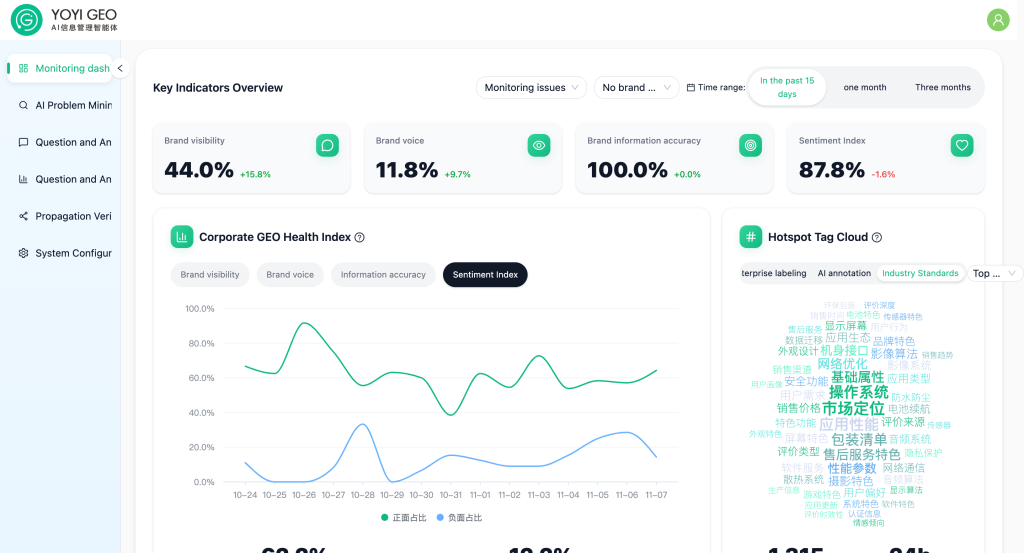
Data Insight Layer: Analyzes metrics such as brand visibility, share of voice, sentiment index, and information accuracy within AI answer engines.
Optimization Implementation Layer: Formulates content and media optimization strategies within the AI context based on the quantitative indicator system for AI brand information, combined with real-time tracking of LLM effects.

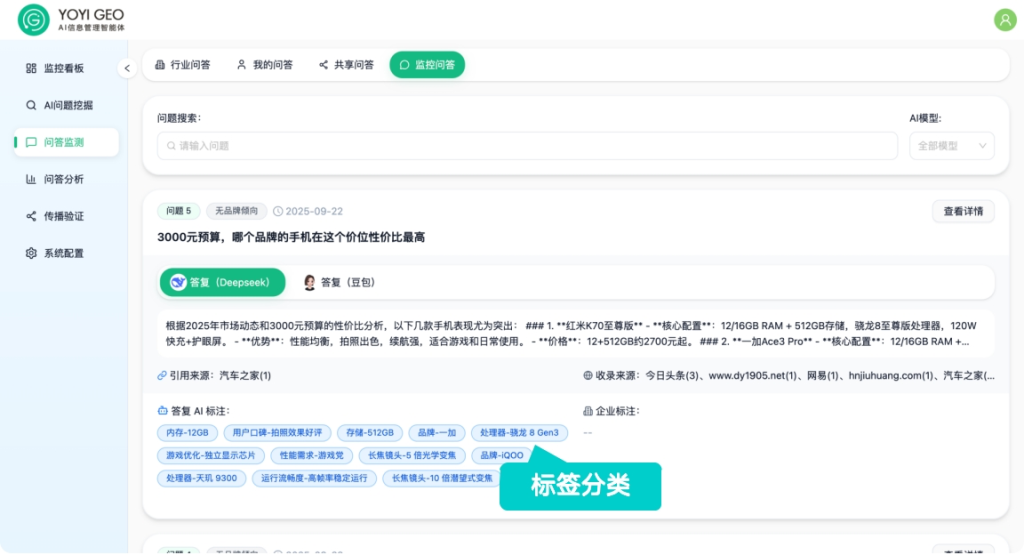
Taking an electronics enterprise as an example, consumers often use LLM platforms like DeepSeek to inquire about product parameters, usage experiences, reviews, and pricing. The YOYI GEO Agent will assist the enterprise in continuously monitoring and capturing consumer questions related to various product lines, and use LLM technology to achieve structured organization and labeled categorization of these questions. Relying on the continuous tracking and analysis of consumer concerns, the YOYI GEO Agent can continuously optimize service effectiveness, while also being able to instantly uncover latent user needs behind the questions.

III. Conclusion

As one of the flagship products of YOYI TECH, the YOYI GEO Agent is committed to solving brand management challenges in the AI search era: it monitors Q&A content on mainstream AI platforms like DeepSeek and Doubao in real-time, accurately identifies user intent and brand topic trends, and provides enterprises with full-cycle brand protection and content strategy support—from early warning and diagnosis to optimization and verification—helping brands master discourse power in AI-generated environments. YOYI TECH will continue to deeply understand the core marketing demands of brands, persistently conduct forward-looking exploration and innovation in cross-industry marketing models, and join hands with brands to achieve traffic growth in the new AI era, co-building a new intelligent marketing ecosystem.

Categories
GEO

The Essential Lesson for Brand Marketing in the AI Era — GEO Q&A Monitoring

In 2025, are you still choosing traditional SEO for brand marketing? According to data from iResearch, users’ ways of obtaining information have undergone a fundamental change: generative AI has already taken 63% of information search traffic, while the effectiveness of traditional SEO has declined by 72%. Search behavior has shifted from the traditional “search–filter” model to a conversational “ask–answer” interaction, placing brand marketing in the midst of unprecedented change. When users no longer click links but directly ask AI, a brand’s visibility in AI-generated answers becomes critically important. Therefore, choosing a systematic AI monitoring tool to ensure the frequency and accuracy of brand mentions across major AI platforms has become a required task for marketers.

The Limitations of Overseas GEO Tools: Why They Struggle in China

Two years ago, the emergence of ChatGPT reshaped the marketing landscape, and overseas advertisers became the first adopters. According to a study by Adobe Express, 36% of respondents stated that they discovered new brands through ChatGPT. To meet this huge market demand, GEO tool companies have sprung up rapidly.

Among them, two tools have attracted wide attention: Profound and Otterly AI.

Profound: This multinational company founded in 2024 in New York has gained seed funding from well-known venture capital firms such as Khosla Ventures and South Park Commons by offering comprehensive and in-depth GEO analysis services, becoming an industry pioneer. Its achievements rely on its detailed analytical dimensions and support for multilingual environments. The main functions of Profound include AI visibility tracking, refined conversation and sentiment analysis, and active crawler optimization. In terms of pricing, it can provide customized pricing based on customer needs, but pricing is generally high.

If Profound is a “battleship,” then Otterly AI is like a “lightweight speedboat.”

Otterly AI: This company was founded in 2023 and is headquartered in Vienna. Compared with the former, this is a more intuitive and easier-to-use AI search tool designed specifically to monitor and optimize performance within generative engines. Its core functions include AI visibility tracking, sentiment analysis, and citation link monitoring. Because of its user-friendly interface, affordable price, and suitability for beginners, the product is particularly suitable for small and medium-sized enterprises and startups whose primary need is monitoring. Both products have their advantages and disadvantages, and whether effectiveness can be maximized depends on the scale and needs of the enterprise.

However, these two excellent products encounter “localization issues” in the Chinese market. Because they primarily target international models, they have limited support for domestic mainstream models such as Doubao, making it difficult to fully cover usage scenarios of Chinese users. In addition, as overseas products, due to qualification and political restrictions, they cannot connect to important channels such as the People.cn mainstream value corpus, creating weaknesses in compliance and localization.

Lastly, in terms of market positioning, Profound is expensive and serves mostly large enterprises, while Otterly AI is affordable but limited in functionality, making both unable to meet the domestic market’s needs for cost-effectiveness and comprehensive capability. These limitations make them difficult to take root in China.

The rise of the YOYI GEO Agent: a new answer within China’s AI ecosystem.

In traditional search scenarios, brands capture user intent by tracking SEO and SEM keywords. But in the AI search era, user queries become more hidden and diverse. However, compared with the overseas market, China’s GEO ecosystem has unique characteristics. Domestic large models do not open user behavior data, making brands feel like they are “fighting blindfolded.”

Against this background, YOYI TECH delivered YOYI GEO Agent focuses on brand information management, optimizing the presentation of brand information in AI Q&A, helping brands truly take the steering wheel of AI marketing.


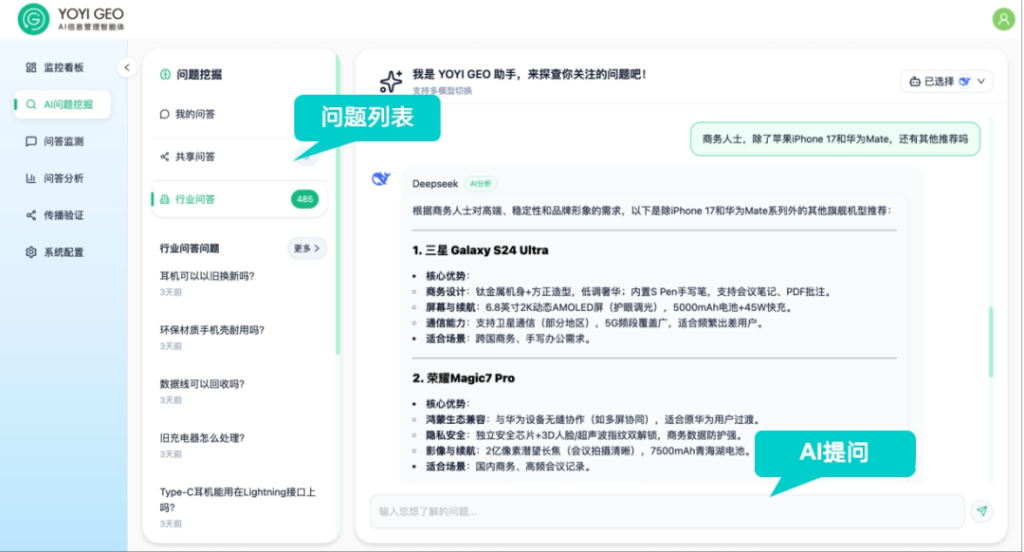
The YOYI GEO Agent integrates user questions from social media, traditional search engines, official website comments, e-commerce reviews, customer service, and other channels. It conducts deep analysis of search volume, question frequency, and sentiment semantics to infer and predict potential user questions on AI platforms. This process helps brands build a precise AI question monitoring list and clarify information management priorities.

Five-Dimensional Deep Analysis System

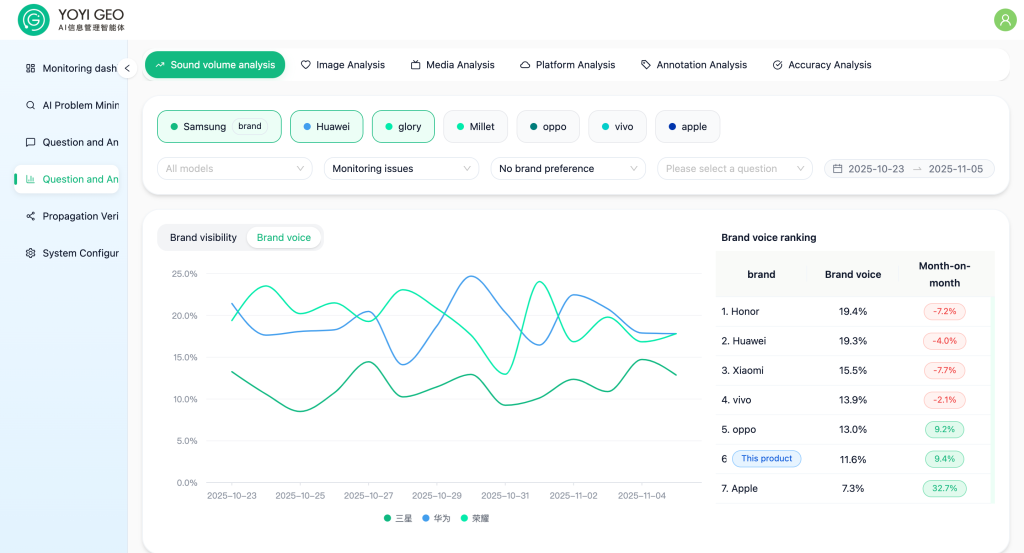
By connecting with official APIs of models such as DeepSeek and Doubao, the YOYI GEO Agent can perform automatic queries and return large amounts of Q&A data. Using semantic analysis technology, it labels answers with structured tags. Based on high-quality data, the system provides deep insights from five core dimensions:
*Brand Share of Voice (SOV): Proportion of mentions compared with competitors
*Information Accuracy: Evaluation of correctness of brand information
*Sentiment Index: Monitoring of positive, neutral, and negative sentiment
*Media Distribution: Analysis of source channels cited in answers
*Tag System: Automatic labeling of brand, product, performance, attributes, etc.


A well-known computer peripheral brand in China achieved significant improvement through the YOYI GEO Agent. After implementation, its AI recommendation rate increased from 56% to 90%, and information accuracy reached 80%.

Implementation Guide

For brands planning to conduct GEO monitoring, we suggest:

Initial Phase: Start monitoring 50–100 core questions, prioritizing those strongly related to brand products and target audiences

Team Setup: Use enterprise main accounts and sub-accounts to assign monitoring permissions across departments

Budget Planning: Use a combination of platform fees + operational services, leveraging industry data and professional strategy teams to maximize AI information management results

With full coverage of domestic mainstream models, a five-dimensional deep analysis system, compliance assurance, and proven effectiveness, the YOYI GEO Agent provides more localized and complete solutions for the Chinese market.


Choose the Right GEO Tool and Take Control in the AI Marketing Era

The surge of AI search will not reverse, and it is reshaping how users encounter information. GEO will be a very clear trend and huge opportunity next year, and more than 90% of marketing professionals are looking for new growth opportunities from it. In this transformation, passive waiting means weakening a brand’s own share of voice. Through the YOYI GEO Agent, brands can systematically mine core questions, monitor AI Q&A dynamics, and analyze answers accurately, ultimately turning the challenges of AI search into a certain force for future growth.

Categories
GEO

Unlock The Mistery of Chinese GEO Ecosystem

As generative AI technology reshapes market dynamics in 2025, the way users access information is rapidly shifting from traditional search engines to AI applications. According to Gartner’s forecast, traditional organic search traffic will drop by over 50% by 2026, with 79% of consumers relying on generative AI for information. In this context, YOYI TECH’s GEO-AI brand monitoring Agent (referred to as “YOYI GEO Agent”) has emerged as a key tool for brands aiming to seize the opportunity at the AI-driven knowledge entry point, powered by its multidimensional core advantages such as technology adaptation, functional coverage, data management, and intelligent analytics.


What is GEO and How it Works

GEO, or Generative Engine Optimization, refers to the process of optimizing brand content across owned media (like websites, blogs, and social media pages), paid media (including news outlets, paid social, and influencer accounts), and earned media (such as reviews, social shares, influencer-generated content, and mentions). This optimization enhances brand visibility, Share of Voice (SoV), information accuracy, and positive sentiment within answers generated by AI search engines like ChatGPT, Gemini, Perplexity, DeepSeek, Doubao, Kimi, and others.

The core purpose of GEO is to amplify brand exposure on relevant AI queries and manage the bias in information accuracy. Ultimately, it drives more targeted traffic to your website and social media platforms, increasing product interest and fostering customer conversion and loyalty.

Given the specific AI Large Language Models (LLM) prevalent in China, the GEO landscape in China differs significantly from that abroad. To understand these nuances and leverage them for greater impact, let’s examine key players in the Chinese GEO market.


Comparison of GEO Providers in China vs. Abroad

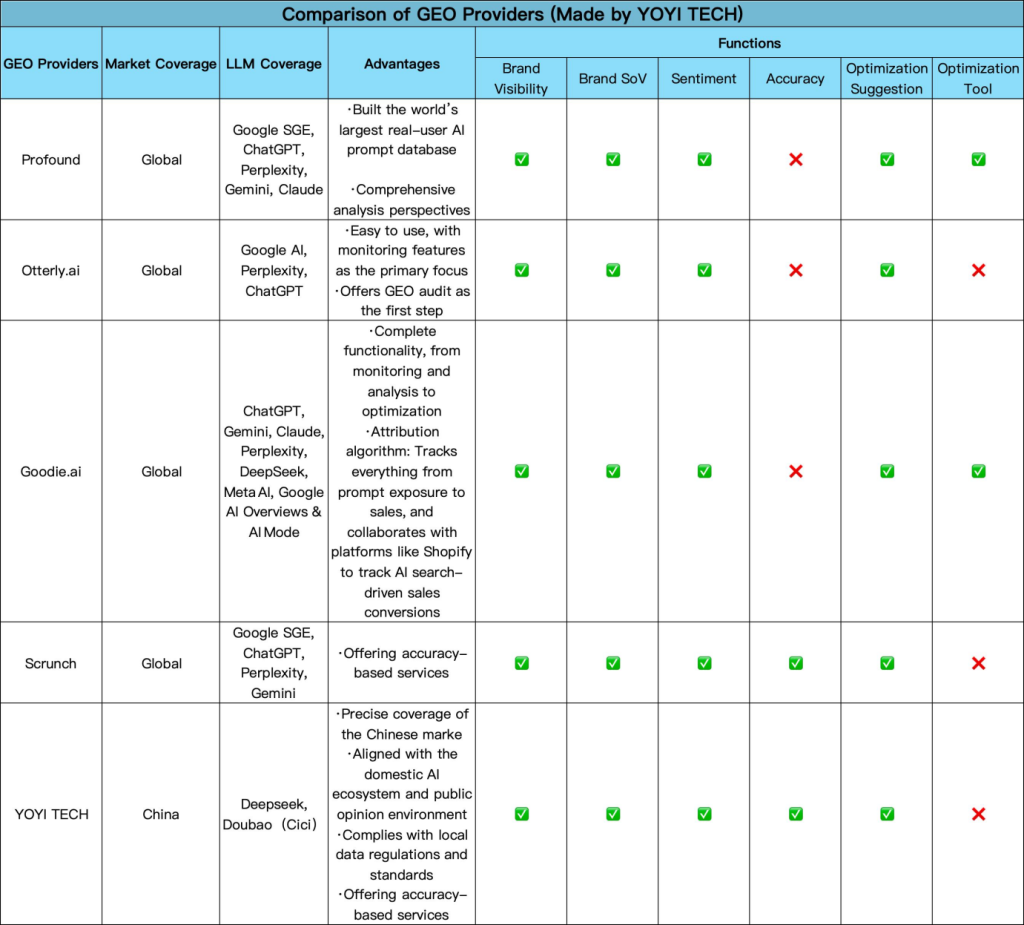
In the global GEO service field, many providers have emerged, each competing with unique advantages and features. This article analyzes YOYI TECH’s GEO product compared to other global GEO providers, highlighting YOYI TECH’s comprehensive functionality and its suitability for the Chinese market.

Globally, providers like Profound, Otterly.ai, Goodie.ai, and Scrunch have expanded their services internationally, demonstrating robust global market presence. YOYI TECH, however, has strategically focused on the Chinese market, enabling it to deeply understand local needs, policies, regulations, and consumer behavior. In terms of large model compatibility, other providers focus on internationally recognized models such as Google SGE, ChatGPT, and Gemini. YOYI TECH, on the other hand, works with models like DeepSeek and Doubao (Cici), which are more widely used and recognized in China, making its services highly suitable for domestic businesses.

Profound has built the world’s largest real-user AI prompt database, offering comprehensive analytical perspectives, which gives it a significant edge in data-driven analysis. Otterly.ai, with its easy-to-use interface, focuses on monitoring features and offers GEO audit as a first step, attracting users who wish to quickly assess their GEO status. Goodie.ai offers complete functionality, with its attribution algorithm tracking everything from prompt exposure to sales, in collaboration with platforms like Shopify to enhance sales conversion tracking.

YOYI TECH’s standout advantage lies in its precise coverage of the Chinese market. By closely aligning with China’s AI ecosystem and public sentiment, YOYI TECH can quickly identify potential risks in a complex and evolving local environment, helping businesses maintain a positive brand image. Additionally, YOYI TECH ensures compliance with local data regulations, mitigating concerns around data security and privacy. Moreover, YOYI TECH provides accuracy-focused services, ensuring that brand information is accurately presented in China’s large models.


YOYI GEO Agent

YOYI TECH’s GEO product directly addresses the changes in user behavior driven by generative AI. It helps brands become AI-prioritized sources by tackling the trend of “AI search zero-click” and optimizing the generative engine (GEO) process. The core functions of YOYI GEO include:

  • End-to-End Brand Monitoring and Optimization: Real-time tracking of brand content across mainstream large models (such as DeepSeek), ensuring continuous AI prioritization by updating content via dynamic knowledge graphs.
  • Public Sentiment and Risk Defense: Detects misinterpretations or low-quality information in AI-generated content, with a risk alert system that helps businesses address potential public opinion crises.
  • Closed-Loop Verification and Iteration: Supports content verification and model reviews to determine if brand content is incorporated into AI systems, and measures the impact of revisions on AI-generated outcomes. This forms a continuous loop of “Publishing – Monitoring – Optimization.”
  • Multi-Dimensional Intelligent Analysis: Provides deep insights for decision-making, analyzing brand exposure, sentiment analysis, media distribution, and impact.
  • Sophisticated Data Management: Ensures flexible data status control and personalized tagging for companies, offering customizable monitoring solutions that meet the needs of different roles within a company

The Chinese GEO market, with its unique local dynamics, presents a significant opportunity for brands looking to leverage AI for enhanced marketing performance. YOYI TECH’s GEO product provides a comprehensive, data-driven solution that optimizes brand exposure, manages public sentiment, and ensures compliance with local data regulations. By focusing on the local AI ecosystem, YOYI TECH helps brands navigate China’s complex market and build sustainable, high-performance marketing ecosystems.

Source of featured image: Photo by Growtika on Unsplash

Exit mobile version